
What Is Particle Decay? How Higgs Boson Decays Reveal the Quantum World

A particle is created.
For an almost unimaginably short moment, it exists.
Then it disappears.
But in particle physics, “disappearing” does not mean vanishing into nothing.
Instead, an unstable particle can transform into other particles.
This process is called particle decay.
And it is one of the most important tools scientists have for studying a world that is far too small — and often far too short-lived — to observe directly.
The Higgs boson is a perfect example.
Physicists cannot simply watch a Higgs boson sitting inside a detector. Once produced in a collision at the Large Hadron Collider, it decays almost immediately into other particles. Scientists therefore study what comes afterward and use those traces to reconstruct what existed before. CERN describes this process as fundamental to how the Higgs boson was discovered and continues to be studied today.
First: What Does “Decay” Actually Mean?
In everyday language, decay suggests deterioration: something slowly breaking apart over time.
Particle physics uses the word differently.
A particle decay is a transformation.
An unstable particle — known as the parent particle — changes into one or more other particles called decay products or daughter particles.
For example, we might symbolically write:
A → B + C
Particle A is the original unstable particle.
Particles B and C are the products that appear after the decay.
The original particle no longer exists as A, but the fundamental conservation laws of physics still apply.
Energy, momentum, electric charge and other relevant quantum quantities must be conserved across the process.
So particle decay is not matter or energy simply disappearing.
It is nature reorganizing a quantum system into another allowed configuration.
Why Do Some Particles Decay?
Not all particles are stable.
Some particle states can transform into states with lower energy or into other combinations of particles permitted by the fundamental interactions of nature.
Quantum mechanics determines the probabilities of these transformations.
This means physicists generally cannot predict the exact instant when one individual unstable particle will decay.
Instead, they can calculate the probability that particles of that type will decay within a particular period of time.
This gives each unstable particle a characteristic average lifetime.
Some live long enough to travel measurable distances.
Others exist for extraordinarily short periods.
The Higgs boson belongs to the second category.
The Higgs Exists for an Almost Unimaginably Short Time
The Higgs boson is extremely unstable.
Once created in a high-energy particle collision, it rapidly transforms into other particles.
That means researchers usually do not detect the Higgs itself.
They detect its decay products.
The process is a little like arriving at the scene of an event after it has already happened.
You do not see the original event directly.
Instead, you examine the evidence that remains.
Particle physicists do something remarkably similar.
They measure the energies, momenta, directions and identities of particles traveling through enormous detectors.
Then they reconstruct the chain of events that produced them.
That reconstruction was essential to the Higgs boson discovery announced by ATLAS and CMS at CERN in 2012.
A Particle Can Decay in More Than One Way
Here is where particle physics becomes especially interesting.
An unstable particle does not necessarily have only one possible decay route.
It can often decay through several different decay channels.
The Higgs boson is an excellent example.
Depending on the interaction involved and the probabilities predicted by the Standard Model, Higgs bosons can produce different combinations of particles.
Possible Higgs decay products include combinations involving:
bottom quarks,
W bosons,
Z bosons,
tau leptons,
photons,
muons.
Some channels are relatively common.
Others are extremely rare.
But even rare decay channels can be scientifically valuable because they may provide exceptionally clean experimental signatures or reveal particular properties of the Higgs.
What Is a Branching Ratio?
Scientists describe the relative probability of a particle following a particular decay channel using something called a branching ratio.
Imagine that an unstable particle could decay through several different doors.
One door might be used frequently.
Another might be used occasionally.
A third might be extraordinarily rare.
The branching ratio tells scientists approximately what fraction of decays follows each possible route.
These probabilities matter enormously.
The Standard Model predicts how often the Higgs should decay through different channels.
Scientists can then compare those predictions with what experiments actually observe.
If a decay repeatedly occurred more or less often than predicted — beyond the uncertainties of the measurements — it could indicate that something is missing from our current understanding.
That is one of the reasons Higgs decay measurements are still so important more than a decade after the particle's discovery.
The Higgs as a Detective Story
Imagine a collision inside the LHC.
Two proton beams collide at extremely high energy.
Among the enormous number of particles and interactions produced, a Higgs boson may occasionally appear.
But the Higgs does not survive long enough to travel through the detector as an identifiable particle.
It decays.
Its decay products travel outward through layers of sophisticated detectors such as ATLAS or CMS.
Those detectors measure their properties.
Computers then process enormous amounts of collision data.
Physicists search for patterns consistent with particular decay processes.
In other words:
scientists reconstruct an invisible particle from the visible traces it left behind.
This is one of the most remarkable aspects of experimental particle physics.
One Particularly Important Higgs Decay: H → ZZ*
One of the most scientifically useful Higgs decay pathways involves Z bosons.
Physicists write the process as:
H → ZZ*
The H represents the Higgs boson.
The two Zs represent two Z bosons.
The asterisk indicates that one of the Z bosons is typically off-shell, meaning it does not have the same mass relationship as a freely propagating Z boson.
The Z bosons themselves are unstable.
So the story continues.
They decay again.
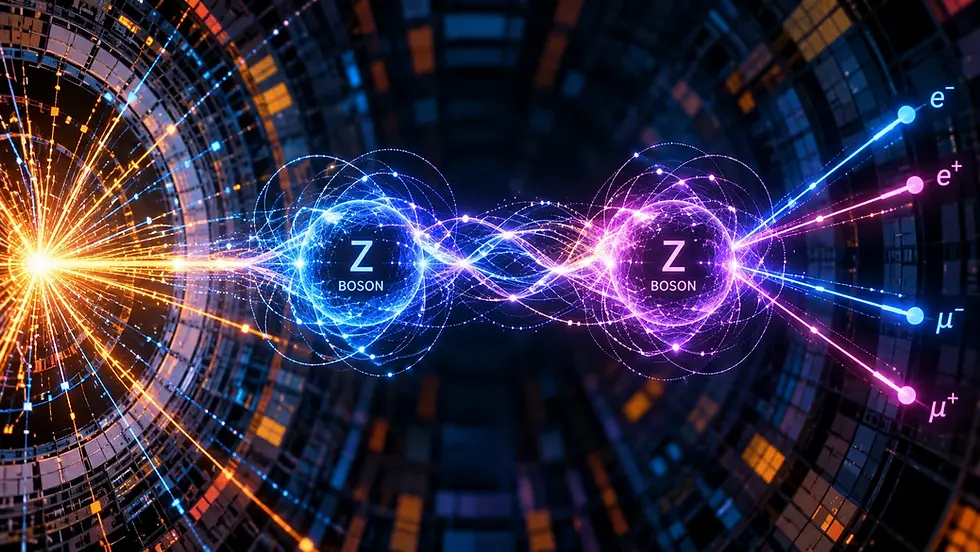
One especially useful final state occurs when the Z bosons produce four charged leptons — electrons or muons:
H → ZZ* → 4ℓ
where ℓ represents a charged lepton.
ATLAS describes this four-lepton process as the “golden channel” because electrons and muons can be measured very precisely and relatively few background processes mimic the same signature. Although the channel is rare, its experimental cleanliness makes it exceptionally valuable.
Why Four Leptons Can Reveal an Invisible Higgs
Suppose researchers detect four leptons emerging from a collision.
They measure their:
energy,
momentum,
direction,
electric charge,
angular relationships.
Using this information, scientists can reconstruct the properties of the Z bosons that produced those leptons.
They can then reconstruct the particle that produced the Z bosons.
If the reconstructed properties match those expected from a Higgs boson, the event becomes a Higgs candidate.
One layer of evidence leads backward to another.
Four leptons.
Two Z bosons.
One Higgs boson.
It is almost like reconstructing a family tree of particles — except the entire chain may have unfolded on a timescale far shorter than anything our senses could perceive.
Why Don't Scientists Simply “See” the Particle?
Particle detectors do not operate like ordinary cameras.
They do not take photographs of tiny objects moving inside the accelerator.
Instead, different detector layers record signals produced when particles pass through or interact with matter.
Researchers combine this information to determine what kinds of particles were present and how they moved.
The original short-lived particle may already be gone.
Its existence is inferred from the structure of the event.
This is why particle physics relies so heavily on statistics.
Many other physical processes can produce similar final particles.
Scientists therefore need enormous datasets to determine whether an excess of particular events represents a genuine particle process rather than statistical fluctuation or background.
The Higgs itself appears only rarely among the enormous number of proton-proton collisions occurring at the LHC.
Decay Is Not the Same as a Particle Exploding
The word “decay” can create another misleading mental image.
A particle is not necessarily a tiny ball that physically breaks into smaller pieces.
Elementary particles are not miniature mechanical objects.
Particle decay is a quantum process.
The daughter particles may even be entirely different types of particles from the parent particle.
What must remain consistent are the conservation laws and the rules governing quantum interactions.
So a better mental model is not:
an object breaking into fragments
but:
one quantum state transforming into another allowed quantum state.
That distinction becomes especially important when discussing particles such as the Higgs.
What Happens to Energy During Decay?
Energy is conserved.
The mass-energy of the original particle becomes distributed among the masses and kinetic energies of the decay products.
Einstein's famous relation
E = mc²
helps remind us that mass and energy are deeply connected.
Momentum must also be conserved.
That is why measuring the motion and energy of the final particles allows scientists to calculate the properties of the parent particle.
In collider experiments, researchers frequently calculate something called invariant mass.
When the decay products originated from the same parent particle, their measured energies and momenta can combine to reveal a characteristic mass associated with that parent.
This technique is one of the foundations of particle discovery.
Lifetime, Decay Width and Probability
Particle physicists use another concept called decay width.
The lifetime of an unstable particle and its decay width are intimately connected.
Very roughly:
shorter lifetime → larger decay width
and
longer lifetime → smaller decay width.
In quantum mechanics, unstable states do not have infinitely precise energies.
Their finite lifetime is related to a characteristic spread in energy represented by the decay width.
This relationship is deeply embedded in the mathematical description of unstable quantum systems.
For a general audience, however, the main point is simple:
the lifetime and decay behavior of a particle contain information about the interactions governing it.
That is another reason physicists measure Higgs decay properties so carefully.
Decays Are Windows Into the Fundamental Forces
Different particle decays occur through different fundamental interactions.
Studying them therefore allows scientists to investigate the forces operating at the smallest scales.
The Z boson, for example, is one of the particles associated with the weak interaction.
When scientists examine Higgs decays involving Z bosons, they are not merely cataloging what the Higgs turns into.
They are studying the relationship between the Higgs field and the electroweak sector of the Standard Model.
Every decay channel is therefore a kind of experimental window.
And different windows reveal different aspects of nature.
Why Rare Decays Matter So Much
It might seem logical that scientists would focus only on the most common Higgs decays.
But some of the rarest channels can be among the most interesting.
Rare decays can provide sensitive tests of the Standard Model.
If an unknown particle or interaction influences a decay process, it might subtly change how frequently the decay occurs or alter the distribution of the final particles.
ATLAS continues to investigate extremely rare Higgs decay modes precisely because they provide additional opportunities to look for deviations from established theory.
So physicists are constantly asking:
Does the Higgs decay exactly as the Standard Model predicts?
So far, measurements have shown remarkable agreement with the theory.
But the search continues.
And Then the Higgs Decay Revealed Something Even Stranger
The story recently took a fascinating turn.
Researchers studying the process
H → ZZ* → 4ℓ
realized that the decay products could reveal more than the existence and properties of the Higgs.
They could also reveal something about the quantum relationship between the two Z bosons themselves.
ATLAS researchers analyzed the angular distributions of the electrons and muons produced by the Z bosons.
Those final particles preserve information about the spin states of their parent Z bosons.
And that information allowed researchers to investigate whether the two Z bosons behaved as independent quantum systems — or whether their quantum states were linked.
The result was striking.
ATLAS reported that the hypothesis of a non-entangled, separable state was disfavored with a statistical significance of 4.7 standard deviations relative to the entangled Standard Model hypothesis. The result provided strong evidence of quantum entanglement between two massive Z bosons produced in Higgs decays.
CMS independently investigated the phenomenon as well, and CERN reported in September 2026 that both collaborations had found strong evidence for entanglement between Z bosons produced in Higgs decay.
Why This Is Remarkable
Quantum entanglement is usually introduced using photons, electrons or carefully controlled laboratory systems.
Here, physicists are investigating it in particles created during some of the most energetic collisions humans can produce.
The Higgs boson is effectively becoming a laboratory for studying quantum information phenomena at extremely high energies.
ATLAS described the result as the first measurements of quantum entanglement between the spins of pairs of Z bosons at the electroweak scale. The peer-reviewed study was published in Physical Review Letters on September 11, 2026.
This does not mean the Z bosons are transmitting messages instantaneously.
Nor does quantum entanglement allow faster-than-light communication.
What it reveals is subtler:
the complete quantum description of two particles can sometimes belong to the combined system, rather than to each particle independently.
And understanding that requires an entirely new chapter.
From Decay to Entanglement
Particle decay may initially sound like destruction.
But from the perspective of modern physics, it is something much richer.
It is transformation.
It is information.
It is one of the principal ways scientists reconstruct events that existed for only fractions of a second.
And now, the decay of the Higgs boson is providing a window into one of the deepest features of quantum mechanics.
We began with a question:
What happens when a particle disappears?
The answer led us from the Higgs…
to Z bosons…
to electrons and muons…
and finally to a quantum relationship that cannot be completely understood by looking at each particle separately.
So the next question becomes unavoidable:
What exactly is quantum entanglement?
That is the next part of the story.
Glossary
ATLASOne of the major particle-physics experiments at CERN's Large Hadron Collider. It was one of the two experiments that discovered the Higgs boson in 2012.
Branching ratioThe fraction or probability of a particle's decays that follows a particular decay channel.
CERNThe European Organization for Nuclear Research, home to the Large Hadron Collider and some of the world's largest particle-physics experiments.
Conservation lawA principle stating that certain physical quantities, such as energy, momentum and electric charge, remain conserved during physical processes.
Daughter particleA particle produced when another unstable particle decays. Also called a decay product.
Decay channelOne particular combination of particles that can result from the decay of an unstable particle.
Decay productA particle produced after an unstable parent particle transforms.
Decay widthA quantity related to the probability and lifetime of an unstable particle. Short-lived particles generally have larger decay widths.
ElectronAn elementary negatively charged particle and one of the fundamental constituents of atoms.
Higgs bosonThe elementary particle associated with the Higgs field. It was discovered by the ATLAS and CMS experiments at CERN in 2012.
Invariant massA quantity calculated from the energies and momenta of a system of particles. It allows physicists to reconstruct the mass of an unstable parent particle from its decay products.
LeptonA family of elementary particles that includes electrons, muons, tau particles and their associated neutrinos.
LHC — Large Hadron ColliderThe world's largest particle accelerator, located at CERN near Geneva.
MuonAn elementary particle similar to the electron but substantially heavier.
Off-shell particleAn intermediate quantum state that does not satisfy the usual mass-energy relationship of a freely propagating particle. In Higgs decay H → ZZ*, the asterisk denotes an off-shell Z boson.
Parent particleThe original unstable particle that transforms during a decay process.
Particle decayThe quantum process through which an unstable particle transforms into other particles.
Quantum entanglementA phenomenon in which the quantum state of two or more particles must be described jointly, producing correlations that cannot be explained by treating the systems as completely independent.
Standard ModelThe theory describing the known elementary particles and three of the four fundamental interactions: electromagnetic, weak and strong.
Weak interactionOne of the four fundamental interactions of nature. W and Z bosons are associated with this interaction.
Z bosonA massive elementary particle that mediates the weak interaction. Z bosons are unstable and rapidly decay into other particles.
References
CERN — The Higgs BosonOverview of the Higgs boson, its discovery and how its decay products are used to study it.https://home.cern/science/physics/higgs-boson/
ATLAS Experiment — ATLAS Explores Quantum Entanglement Using Higgs Boson Decays, While Charting Its Properties — June 5, 2026Explains the H → ZZ* → 4ℓ “golden channel,” Higgs decay reconstruction and the ATLAS entanglement analysis.https://atlas.cern/Updates/Briefing/Run3-Higgs-4l
CERN — Strong Evidence for Quantum Entanglement Between Z Bosons Found by ATLAS and CMS — September 17, 2026CERN’s official report on the strong evidence for quantum entanglement between Z bosons produced in Higgs decays.https://home.cern/strong-evidence-for-quantum-entanglement-between-z-bosons-found-by-atlas-and-cms/
ATLAS Collaboration — Measurements of Z-Boson Pair Entanglement in Decays of Higgs Bosons at the ATLAS Experiment — Physical Review Letters 137, 111804 — September 11, 2026The peer-reviewed scientific paper reporting the ATLAS measurement and the 4.7σ rejection of the separable-state hypothesis.https://journals.aps.org/prl/abstract/10.1103/y1nh-1b82
ATLAS Experiment — ATLAS Finds Evidence for One of the Higgs Boson’s Rarest Decays — September 14, 2026Useful supporting reference explaining why rare Higgs decay channels are scientifically important.https://atlas.cern/Updates/Briefing/Rare-Light-Higgs-Decay


Comentários