
What Is Quantum Entanglement? When Two Particles Can No Longer Be Described Separately
What if two particles can no longer be completely understood as two separate things?
This is one of the most extraordinary ideas in modern physics.
It is called quantum entanglement.
Entanglement does not mean that two particles are connected by an invisible cable.
It does not mean that they are secretly exchanging messages faster than light.
And it certainly does not mean that everything in the Universe is automatically connected to everything else.
The reality is stranger — and more precise.
When particles become entangled, the most complete description of the system may belong to the pair as a whole, rather than to each particle independently.
And in 2026, this phenomenon appeared in an especially remarkable place:
inside the decay of the Higgs boson.
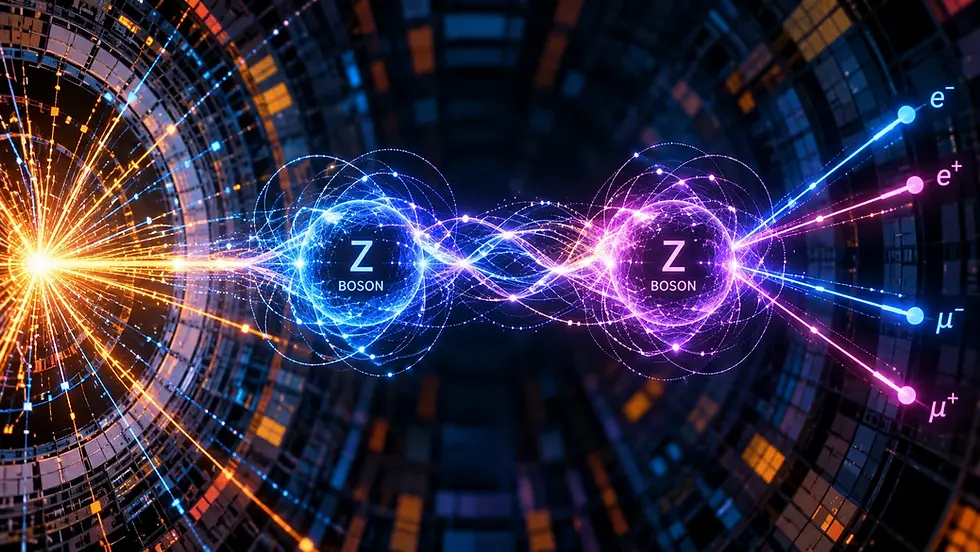
Researchers at CERN's ATLAS and CMS experiments found strong evidence that two Z bosons produced in Higgs decays can form an entangled quantum system.
To understand why that matters, however, we need to go back to one of the deepest questions ever asked about reality.
Before Entanglement: How We Expect the World to Work
Imagine two boxes.
Inside each box is a ball.
One ball is red.
The other is blue.
You separate the boxes without looking inside.
One travels to Paris.
The other travels to Tokyo.
When you open the box in Paris and find the red ball, you immediately know that the Tokyo box contains the blue one.
Nothing mysterious happened.
The colors were already determined before the boxes separated.
You simply did not know which box contained which ball.
This is an example of an ordinary classical correlation.
Quantum entanglement is different.
In an entangled system, quantum mechanics does not necessarily allow us to describe the particles as if each one carried a complete, independent set of predetermined properties waiting to be revealed.
Instead, certain properties belong to the combined quantum state.
That distinction is at the heart of entanglement.
A Quantum System Is More Than the Sum of Its Parts
In classical physics, we usually assume that if we know everything about every individual part of a system, we know everything about the whole system.
Quantum mechanics changes this.
Consider two particles called A and B.
If they are independent, we can describe particle A separately from particle B.
Symbolically:
State of A × State of B
But an entangled state cannot always be separated this way.
There may be no complete description of particle A that is independent of particle B.
Mathematically, their joint state cannot be written simply as a product of two independent states.
This is what physicists mean by a non-separable state.
And that mathematical idea has measurable physical consequences.
Schrödinger Gave the Phenomenon Its Name
The word entanglement comes from physicist Erwin Schrödinger.
In 1935, Schrödinger used the German word Verschränkung while discussing one of the most troubling implications of quantum mechanics.
That same year, Albert Einstein, Boris Podolsky and Nathan Rosen published a famous paper questioning whether quantum mechanics provided a complete description of physical reality.
Their argument became known as the EPR paradox.
Einstein was deeply uncomfortable with the idea that measurements performed on distant quantum systems could produce correlations that appeared incompatible with the classical picture of independently existing objects.
He suspected something might be missing from quantum theory.
Perhaps, he thought, particles possessed hidden properties that quantum mechanics simply did not describe.
That possibility became known as a hidden-variable theory.
For decades, the debate remained largely philosophical.
Then John Bell changed everything.
Bell Turned a Philosophical Question Into an Experiment
In 1964, physicist John Stewart Bell discovered a remarkable way to distinguish between certain classical hidden-variable explanations and the predictions of quantum mechanics.
He derived mathematical relationships now known as Bell inequalities.
If particles possessed predetermined local properties of the sort envisioned by many classical models, their measurement correlations would have to remain within particular statistical limits.
Quantum mechanics predicted that entangled particles could exceed those limits.
Experiments eventually did exactly that.
Repeated tests using photons, atoms and other quantum systems have violated Bell inequalities in ways consistent with quantum mechanics.
The implication was profound.
The correlations predicted by quantum entanglement cannot generally be reproduced by a simple theory in which each particle merely carries an independent set of predetermined local instructions.
Quantum mechanics was not simply hiding ordinary classical information from us.
Something genuinely different was occurring.
Does Measuring One Particle Change the Other Instantly?
This is where explanations of entanglement often become misleading.
You may have heard:
“Measure one particle and the other instantly changes.”
That sentence can create the wrong mental image.
It sounds as though particle A sends a signal to particle B.
But quantum mechanics does not allow entanglement to be used for controllable faster-than-light communication.
Suppose two observers share an entangled pair.
Each observer's individual measurement result is intrinsically unpredictable.
Only when the two sets of measurements are later compared do the characteristic quantum correlations become apparent.
So entanglement produces extraordinarily strong correlations.
But it does not provide a cosmic telephone.
No usable message is being transmitted faster than light.
Then What Is Actually Connected?
Not the particles in the ordinary mechanical sense.
What is linked is their quantum description.
A useful way to think about it is this:
Before measurement, quantum mechanics may not assign an independent definite value of a particular property to each particle.
Instead, it assigns a state to the pair.
The relationship is fundamental.
This leads to one of the most counterintuitive lessons of quantum physics:
sometimes the whole contains information that cannot be assigned separately to its parts.
This idea has become increasingly important not only in fundamental physics, but also in quantum computing, quantum cryptography and quantum information science.
How Does Quantum Entanglement Work Through Particle Spin?
One property often used to study entanglement is spin.
Spin does not mean that a particle is literally spinning like a tiny planet.
It is an intrinsic quantum property associated with angular momentum.
Different types of particles can have different possible spin states.
For example, certain particles effectively provide two measurement outcomes for a chosen spin direction.
But the Z boson is different.
A Z boson has spin 1.
That means its spin projection can occupy three possible states:
−1, 0 or +1
A quantum system with three possible basis states is sometimes called a qutrit.
This makes pairs of Z bosons particularly interesting from the perspective of quantum information.
Enter the Higgs Boson
Now we return to the Higgs.
As we explored in the previous article, the Higgs boson is extremely unstable.
One of its possible decay processes is:
H → ZZ*
The Higgs transforms into two Z bosons.
The Z bosons then decay almost immediately.
One particularly useful final state is:
H → ZZ* → 4ℓ
where ℓ represents a charged lepton — usually an electron or a muon in these analyses.
The final particles can therefore appear as combinations such as:
e⁻ + e⁺ + μ⁻ + μ⁺
The ATLAS and CMS detectors can measure these particles with extraordinary precision.
And hidden inside their trajectories is information about the quantum states of the Z bosons that existed before them.
But the Z Bosons Disappear Almost Immediately
This creates a fascinating experimental problem.
Physicists cannot place a Z boson on a laboratory table and directly measure its spin.
Z bosons decay almost immediately.
So how can researchers investigate whether two Z bosons were entangled?
By studying their descendants.
When a Z boson decays into leptons, the directions in which those leptons emerge depend on the polarization state of the parent Z boson.
Researchers therefore measure the angles and momenta of electrons and muons produced in the decay.
From those patterns, they can reconstruct statistical information about the spin states of the original Z bosons.
In a sense, the final particles preserve traces of the quantum relationship that existed before the Z bosons disappeared.
Reading Quantum Information From Four Particles
Imagine the Higgs decays into two Z bosons.
Then:
Z₁ → ℓ⁺ + ℓ⁻
and
Z₂ → ℓ⁺ + ℓ⁻
Researchers measure the four leptons produced.
But they are not simply asking:
“Where did these particles go?”
They study the complete geometry of the event.
The angles between the leptons.
The orientation of their decay planes.
Their momenta.
Their energies.
From these distributions, scientists can reconstruct aspects of something called the spin-density matrix.
This mathematical object describes the statistical quantum state of the Z-boson pair.
And it allows researchers to ask a crucial question:
Could the observed data be explained if the two Z bosons had independent, separable quantum states?
Or does the data require an entangled state?
What ATLAS Found
In 2026, the ATLAS Collaboration reported the first measurements of quantum entanglement between the spins of pairs of Z bosons at the electroweak scale.
The researchers used proton–proton collision data collected at the Large Hadron Collider at collision energies of 13 and 13.6 TeV.
They studied the process:
H → ZZ* → ℓ⁺ℓ⁻ℓ⁺ℓ⁻
and analyzed angular observables sensitive to the quantum state of the Z-boson pair.
A complementary analysis using the full angular distribution compared two possibilities:
an entangled Standard Model state
versus
a separable state in which the two bosons could be described independently.
The separable-state hypothesis was disfavored with a statistical significance of:
4.7 sigma
The expected sensitivity was 4.9 sigma.
That constitutes strong evidence for quantum entanglement between the two massive Z bosons.
What Does 4.7 Sigma Mean?
Particle physicists often express statistical significance using the Greek letter sigma: σ.
The larger the number of sigma, the less likely it is that a result resembling the observed one would arise from ordinary statistical fluctuation under the hypothesis being tested.
In particle physics, a significance of 5 sigma is traditionally used as the benchmark for claiming a discovery.
So 4.7 sigma is extremely strong evidence — but the careful scientific language remains important.
The ATLAS result is therefore described as strong evidence, rather than simply declaring a new fundamental phenomenon discovered from scratch.
Quantum entanglement itself, of course, has already been demonstrated many times.
What is new is the system in which it is being observed.
Why Z Bosons Are Different
Entanglement has been studied extensively with photons, electrons, atoms and other relatively low-energy quantum systems.
The Z boson is something very different.
It is a massive carrier of the weak interaction.
Its mass is approximately 91 GeV/c².
It exists for only an extraordinarily short time.
And at the LHC, these bosons are produced in some of the highest-energy laboratory collisions on Earth.
This means that physicists are now studying concepts from quantum information science in the realm of high-energy particle physics.
The boundary between two fields is beginning to blur.
From Qubits to Qutrits
Another intriguing difference is dimensionality.
Many introductory examples of quantum information involve qubits — systems with two basic quantum states.
A spin-1 Z boson can occupy three polarization states:
−1
0
+1
That makes it analogous to a qutrit, a three-level quantum system.
Two Z bosons therefore form a richer quantum system than the simple two-state examples often used to introduce entanglement.
This is one reason the result is scientifically interesting.
Researchers are expanding experimental studies of quantum information into increasingly complex and energetic systems.
What CMS Found
ATLAS was not alone.
The CMS Collaboration independently investigated quantum entanglement in Higgs decays to pairs of Z bosons.
CMS reconstructed the polarization information of the Z bosons through the angular distributions of their lepton decay products.
Their analysis likewise found evidence consistent with the Z-boson pair forming an entangled quantum system.
CMS also emphasized an important experimental limitation:
a fully direct Bell test cannot be carried out in the same way it can be performed in controlled low-energy quantum experiments.
The Z bosons decay far too quickly for researchers to independently choose and perform spin measurements on each particle after they separate.
Instead, their quantum properties must be inferred statistically from the particles into which they decay.
That distinction matters.
So Was This a Bell Test?
Not in the classic sense.
A traditional Bell experiment typically allows researchers to choose different measurement settings independently for separated quantum systems.
With Z bosons produced inside LHC collisions, physicists do not have that freedom.
The bosons decay almost immediately.
Researchers analyze their decay products after the fact.
ATLAS therefore used entanglement-sensitive observables and a statistical comparison between entangled and separable-state hypotheses.
The analysis provides strong evidence of entanglement.
But we should not describe it as though scientists placed two Z bosons meters apart and performed a textbook Bell experiment on them.
That would misrepresent what was actually measured.
Is Distance Necessary for Entanglement?
No.
This is another common misconception.
Entanglement is often described using two particles separated by enormous distances because this emphasizes how strange the correlations are.
But distance is not what creates entanglement.
Two particles can be entangled while very close together.
They can also remain entangled after becoming widely separated, provided interactions with the environment do not destroy the coherence necessary to preserve the joint state.
In the Higgs experiment, the central question is therefore not how far apart the Z bosons travel.
They barely have time to travel at all.
The interesting question is:
Were their quantum states separable, or did the two bosons form one inseparable quantum system?
The evidence favors the latter.
Does Entanglement Mean “Everything Is Connected”?
No.
This phrase is attractive, but scientifically it goes much further than the evidence allows.
Quantum entanglement occurs between specific quantum systems that share an appropriate joint state.
It is not a scientific demonstration that every object, person or event in the Universe remains permanently entangled with every other one.
Interactions with the surrounding environment also tend to destroy observable quantum coherence through a process known as decoherence.
That is one reason the strange behavior of microscopic quantum systems is not normally obvious in everyday life.
Entanglement is extraordinary enough without adding claims that physics itself does not make.
What Is Decoherence?
A perfectly isolated quantum system can preserve delicate relationships between different possible states.
But real systems interact with their environments.
Photons collide with them.
Atoms interact.
Heat exchanges occur.
Information about the quantum system spreads into the surrounding environment.
As this happens, the coherent relationships required to observe certain quantum effects become increasingly difficult to preserve.
This process is called decoherence.
Decoherence helps explain why the macroscopic world around us usually appears classical even though it is ultimately built from quantum systems.
It does not mean quantum mechanics stops working.
Rather, quantum information becomes dispersed into a much larger environment.
Entanglement Is Not a Force
Another useful distinction:
entanglement is not a fifth force of nature.
There is no “entanglement force” pulling two particles toward one another.
An entangled pair does not behave like two magnets.
Entanglement describes the structure of a quantum state and the correlations between measurement outcomes.
This is conceptually different from forces such as:
gravity,
electromagnetism,
the strong interaction,
the weak interaction.
The Z boson itself participates in the weak interaction.
But its entanglement with another Z boson is not an additional force acting between them.
Why Use the Higgs to Study Quantum Information?
This is perhaps the most exciting part of the 2026 result.
The Higgs boson is no longer only an object physicists want to understand.
It is becoming a tool.
Because the Higgs has spin zero, its decays impose very specific relationships on the polarization states of the particles it produces.
Those relationships make Higgs decays an excellent laboratory for studying quantum correlations.
Researchers can therefore use the Higgs as a new probe of the quantum structure of high-energy interactions.
The same particle whose discovery confirmed a central part of the Standard Model is now helping scientists test quantum mechanics in a regime that was previously difficult to access.
Could Entanglement Reveal New Physics?
Potentially.
The Standard Model predicts specific patterns of Higgs interactions and Z-boson polarization.
If future experiments measure entanglement patterns that differ significantly from those predictions, the discrepancy could indicate that unknown interactions are affecting the process.
This does not mean the 2026 result has already discovered physics beyond the Standard Model.
It has not.
The measurements are consistent with Standard Model expectations.
But quantum observables provide scientists with an additional way to search.
Instead of asking only:
How many particles were produced?
or
How much energy did they carry?
physicists can also ask:
What was the structure of their joint quantum state?
That creates an entirely new category of information.
The Higgs as a Quantum Laboratory
This is the larger significance of the result.
Historically, quantum information experiments and high-energy particle physics developed largely as separate research areas.
One studied carefully controlled photons, atoms or superconducting circuits.
The other studied violent collisions producing short-lived elementary particles.
Now those worlds are beginning to meet.
At CERN, scientists are effectively asking:
Can techniques developed to understand quantum information tell us something new about the fundamental particles and forces?
And conversely:
Can extreme particle collisions become laboratories for testing the deepest principles of quantum mechanics?
The answer increasingly appears to be yes.
The High-Luminosity LHC Could Take This Further
The next major opportunity will come from the High-Luminosity Large Hadron Collider, or HL-LHC.
Its goal is to dramatically increase the number of particle collisions recorded by experiments such as ATLAS and CMS.
More collisions mean more Higgs bosons.
More Higgs bosons mean more rare H → ZZ* → 4ℓ events.
And more events mean much more precise measurements of quantum correlations.
What today appears as strong evidence may eventually become a detailed map of how entanglement behaves in some of the most energetic quantum systems ever studied experimentally.
The Deeper Lesson
Quantum entanglement is often presented as though its mystery lies in two distant particles somehow “communicating.”
But perhaps the deeper mystery is different.
Our everyday intuition tells us that reality is made of separate objects.
Object A exists here.
Object B exists there.
Each should possess its own independent properties.
Quantum mechanics tells us that nature does not always organize itself that way.
Sometimes the most complete description belongs not to the individual components...
but to the system formed by their relationship.
And now we can observe evidence of that principle not only in delicate laboratory experiments with photons or atoms...
but inside the fleeting decay of the Higgs boson.
Two Z bosons appear.
They survive for only a fraction of a fraction of a second.
They decay.
They disappear.
Yet the particles they leave behind preserve enough information for scientists to discover something remarkable about the state that existed before them:
the two bosons could not be completely described independently.
Perhaps the strangest thing about quantum physics is therefore not what a particle is.
It is what can exist between particles.
Glossary
ATLAS: One of the two large general-purpose particle detectors at CERN's Large Hadron Collider. ATLAS performed the 2026 measurement that provided strong evidence for entanglement between Z-boson spins in Higgs decays.
Bell inequality: A mathematical constraint satisfied by broad classes of local hidden-variable theories. Quantum mechanics predicts — and experiments have observed — correlations that can violate Bell inequalities.
Bell test: An experiment designed to compare quantum predictions with restrictions imposed by local hidden-variable models. The 2026 Z-boson measurements are not equivalent to a traditional freely chosen Bell test.
CERN: The European Organization for Nuclear Research, home to the Large Hadron Collider near Geneva.
CMS: The Compact Muon Solenoid experiment at CERN. CMS independently investigated quantum entanglement in Higgs decays to Z-boson pairs.
Coherence: The preservation of phase relationships between components of a quantum state, allowing quantum interference and other distinctly quantum phenomena to occur.
Decoherence: The process through which interactions with the surrounding environment disperse quantum information and suppress observable coherent quantum behavior.
Entangled state: A joint quantum state that cannot be completely represented as independent states assigned separately to each component of the system.
EPR paradox: The argument proposed in 1935 by Einstein, Podolsky and Rosen questioning whether quantum mechanics provided a complete description of physical reality.
Higgs boson: The elementary particle associated with the Higgs field. In the process discussed here, a Higgs boson decays into two Z bosons whose quantum correlations can be studied.
Hidden-variable theory: A theory proposing that apparently random quantum outcomes are determined by additional underlying variables not included in the standard quantum description.
Lepton: A family of elementary particles including electrons, muons, tau particles and neutrinos.
Locality: Broadly, the principle that physical influences do not propagate instantaneously across arbitrary distances. Bell's theorem showed that certain local hidden-variable models cannot reproduce all quantum predictions.
Muon: An elementary particle similar to the electron but significantly heavier. Muons produced in Z-boson decays can be measured precisely by particle detectors.
Non-separable state: Another term for an entangled state: a quantum state that cannot be factored into independent states for its individual components.
Polarization: The quantum orientation associated with a particle's spin state. Z bosons can occupy three polarization states.
Quantum entanglement: A property of composite quantum systems in which the complete quantum state cannot be described as independent states of the individual components.
Quantum information: The study of how information is represented, processed and transmitted in quantum systems.
Qubit: A two-level quantum system used as the fundamental unit of quantum information in many quantum technologies.
Qutrit: A three-level quantum system. Because Z bosons have three possible spin projections, their polarization states can be treated as qutrit-like systems.
Separable state: A composite quantum state that can be expressed as independent quantum states for its individual components. A separable state is not entangled.
Sigma (σ): A statistical measure commonly used in particle physics to indicate how strongly data disfavors a particular hypothesis.
Spin: An intrinsic quantum property associated with angular momentum. It is not the same as a classical object physically rotating around its axis.
Spin-density matrix: A mathematical representation describing the statistical quantum state and correlations of particle spins or polarizations.
Standard Model: The theory describing the known elementary particles and the electromagnetic, weak and strong fundamental interactions.
Z boson: A massive spin-1 particle that mediates the weak interaction. A Z boson can occupy three spin-projection states and decays extremely rapidly.
References
ATLAS Collaboration — Measurements of Z-Boson Pair Entanglement in Decays of Higgs Bosons at the ATLAS Experiment Physical Review Letters, Vol. 137, 111804. Published September 11, 2026. https://journals.aps.org/prl/abstract/10.1103/y1nh-1b82
CERN — Strong Evidence for Quantum Entanglement Between Z Bosons Found by ATLAS and CMS Official CERN overview of the 2026 ATLAS and CMS results. https://home.cern/strong-evidence-for-quantum-entanglement-between-z-bosons-found-by-atlas-and-cms/
ATLAS Experiment — ATLAS Explores Quantum Entanglement Using Higgs Boson Decays, While Charting Its Properties ATLAS Physics Briefing, June 5, 2026. https://www.atlas.cern/Updates/Briefing/Run3-Higgs-4l
Einstein, Podolsky and Rosen — Can Quantum-Mechanical Description of Physical Reality Be Considered Complete? Physical Review, Vol. 47, 777. Published May 15, 1935. https://journals.aps.org/pr/abstract/10.1103/PhysRev.47.777
John S. Bell — On the Einstein Podolsky Rosen Paradox Physics Physique Fizika, Vol. 1, 195. Published November 1, 1964 https://doi.org/10.1103/PhysicsPhysiqueFizika.1.195


Comentários