
What Is the Higgs Boson, After All?

You have probably heard of the Higgs boson.
Maybe even by its most famous — and also most controversial — nickname: the “God particle.”
But what is it, really?
To understand it, it helps to imagine a simple scene.
Imagine the Universe as an Invisible Ocean
Picture the entire Universe filled with an invisible ocean.
That “ocean” would be the Higgs field.
It is not a liquid, of course. It is a fundamental quantum field that, according to the Standard Model of particle physics, exists throughout space.
Some particles interact strongly with this field.
Others interact with it less.
And this interaction is related to the mass of several elementary particles.
That is how particles such as the W and Z bosons, electrons, and quarks acquire mass within the Standard Model.
So Where Does the Higgs Boson Come In?
Now imagine a wave in that ocean.
The wave is not the entire ocean.
It is a manifestation of it.
That is a simple way to visualize the relationship between the Higgs field and the Higgs boson.
The Higgs boson is the particle associated with this quantum field.
In the language of quantum physics, particles can be understood as excitations of fields. So if the Higgs field really existed, there should also be a particle associated with it.
Detecting that particle would be a way to experimentally verify the existence of the field predicted by the theory.
And that is exactly what happened.
A Prediction Made Almost 50 Years Before the Discovery
The mechanism now known as the Brout–Englert–Higgs mechanism was developed in 1964.
François Englert and Robert Brout proposed the idea in one paper, while Peter Higgs published an independent proposal related to the same mechanism.
The theory helped solve a major problem in physics:
how could certain fundamental particles have mass without breaking the mathematical structure of electroweak theory?
The Higgs mechanism provided the answer.
But there was a problem.
The particle predicted by the theory was extremely difficult to find.
Why Did It Take So Long to Find It?
The Higgs boson is extremely unstable.
According to CERN, its average lifetime is on the order of 10⁻²² seconds.
That is so short that it essentially disappears almost as soon as it is produced.
For that reason, scientists cannot simply “photograph” a Higgs boson.
They have to produce it in particle collisions and then analyze what it transforms into — in other words, its decay products.
A particle accelerator powerful enough to create Higgs bosons in sufficient numbers was required so that their signals could be identified statistically.
That accelerator was the Large Hadron Collider — LHC, at CERN.
The Day the Higgs Appeared
On July 4, 2012, the ATLAS and CMS collaborations announced at CERN the discovery of a new particle.
The data showed a particle with no electric charge, an extremely short lifetime, and decay patterns compatible with what physicists expected from the Higgs boson.
With more data, researchers confirmed that its properties matched those expected for a Higgs boson.
It was one of the most important discoveries in modern physics.
A theory formulated almost half a century earlier had finally found experimental evidence.
And the Nobel Prize?
In 2013, François Englert and Peter Higgs received the Nobel Prize in Physics for the theoretical discovery of the mechanism that helps explain the origin of the mass of subatomic particles.
The Nobel Committee highlighted that the theory had been confirmed by the discovery of the predicted particle in the ATLAS and CMS experiments at the LHC.
So Does the Higgs “Give Mass to Everything”?
No.
That is a common simplification, but it is incorrect.
The Higgs mechanism explains the mass of several elementary particles, including the W and Z bosons, electrons, and quarks.
But much of the mass of ordinary matter does not come directly from the Higgs field.
For example, protons and neutrons are made of quarks and gluons, and most of their mass comes from the energy associated with the strong interaction inside those particles.
In other words:
the Higgs field is fundamental to the physics we know, but it is not the only source of mass in the Universe.
Why Is the Higgs Still So Important?
The 2012 discovery did not end the story.
In fact, it opened a new one.
Since then, scientists have been studying how the Higgs interacts with other particles, how often it is produced, and which types of decay it undergoes.
These measurements allow physicists to test the Standard Model with enormous precision.
And any unexpected deviation could point to something even more interesting:
physics beyond the Standard Model.
That is why the Higgs continues to be studied intensively at CERN.
And Now There Is a New Surprise
In 2026, the Higgs boson returned to the spotlight for another reason.
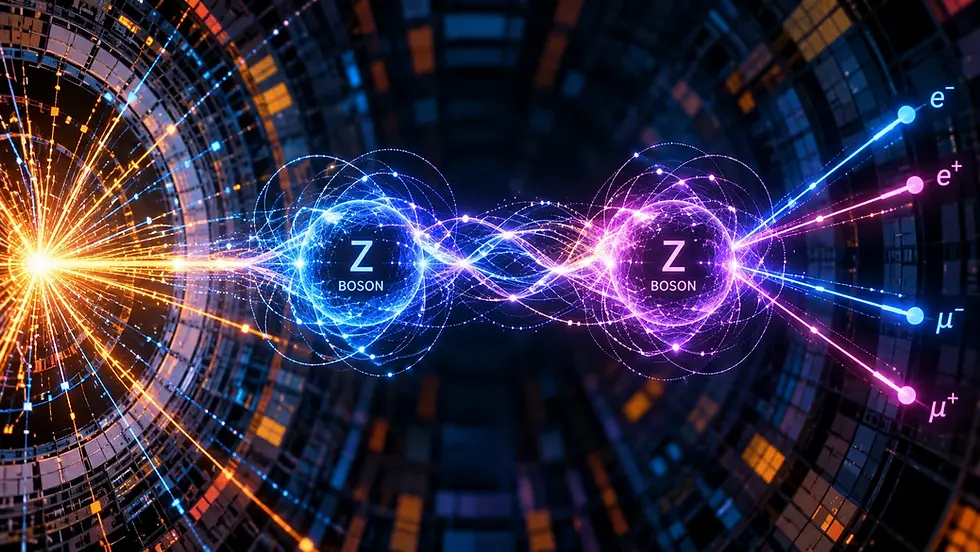
Researchers found strong evidence of quantum entanglement between Z bosons produced in Higgs decay.
This opened a new way to explore quantum phenomena at extremely high energies.
But that is the next part of the story.
Before understanding entanglement, we first need to understand one thing:
what exactly happens when a particle like the Higgs “decays”?
That is what we will explore in the next piece of content.
Glossary
ATLAS and CMS: Two major LHC experiments used to study particle collisions and that played key roles in the discovery of the Higgs boson.
Binding energy: The energy associated with the interaction between particles inside a system. In protons and neutrons, much of the observed mass comes from the energy of the strong interaction between quarks and gluons, consistent with E = mc².
CERN: The European Organization for Nuclear Research, one of the world’s leading centers for particle physics.
Decay: The process by which an unstable particle transforms into other particles.
Electron: An elementary particle with negative electric charge, found in atoms.
Electroweak theory: A theory that unifies the electromagnetic interaction and the weak interaction within a single mathematical framework.
Elementary particle: A particle that, as far as we know, is not made of smaller components.
Gluon: The particle associated with the strong interaction, responsible for binding quarks together inside protons and neutrons.
Higgs boson: An elementary particle associated with the Higgs field. Its detection confirmed a central part of the Standard Model of particle physics.
Higgs field: A quantum field that permeates the Universe and interacts with certain particles, contributing to their mass.
Higgs mechanism: The theoretical process that explains how certain fundamental particles acquire mass through interaction with the Higgs field.
LHC — Large Hadron Collider: The world’s largest particle accelerator, located at CERN.
Physics beyond the Standard Model: A general term for theories and phenomena that are not fully explained by the current Standard Model.
Quantum chromodynamics (QCD): The theory that describes the strong interaction between quarks and gluons. The energy stored in these interactions contributes decisively to the mass of protons and neutrons.
Quantum entanglement: A phenomenon in which two or more particles show quantum correlations that must be described as part of a shared system.
Quantum field: A fundamental structure in quantum physics that exists throughout space. Particles can be understood as excitations of these fields.
Quark: An elementary particle that helps form protons, neutrons, and other composite particles.
Standard Model: The theory that describes the known fundamental particles and three of the four fundamental interactions of nature: electromagnetic, strong, and weak.
Strong interaction: One of the four fundamental interactions of nature. It holds quarks together inside protons and neutrons and is described by quantum chromodynamics.
W and Z bosons: Particles responsible for the weak interaction, one of the four fundamental interactions of nature.
References
CERN — The Higgs boson https://home.cern/science/physics/higgs-boson/
CERN — What’s so special about the Higgs boson? https://home.cern/science/physics/higgs-boson/what/
CERN — How did we discover the Higgs boson? https://home.cern/science/physics/higgs-boson/how/
Nobel Prize — The Nobel Prize in Physics 2013 https://www.nobelprize.org/prizes/physics/2013/summary/


Comentários